Signed in as:
filler@godaddy.com
A card—or a relationship between cards—may illuminate something already moving within you. The same drawing can speak differently to another person, or even to you at another moment.
An early reader’s first draw
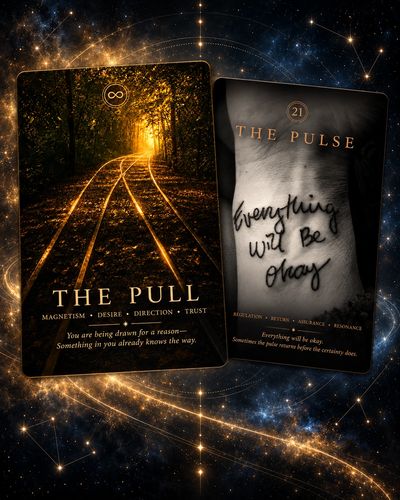
An early reader drew these cards together and immediately recognized something unfolding in her own life—a strong pull toward a project she cared deeply about, alongside the pulse of uncertainty about where it might lead.
When she shared her drawing with me, something else happened:
I recognized myself in it, too.
The Pull and The Pulse spoke directly to my own journey of creating the Metta Constellation—following what kept calling me forward while listening for what felt alive, true, and ready to become.
Same cards.
Different lives.
A shared constellation.
That is part of the invitation of this oracle: Not to tell you what your life means.
To offer something you can enter into relationship with—and notice what becomes visible from there.
A draw inspired by a wedding celebration toast
After hearing a wedding toast to two friends whose relationship had found its way back to itself after decades, I kept thinking about their story.
I drew three cards:
The Pull → The Resonance Field → Homecoming
The sequence felt almost narrative.
The Pull: Something kept calling across all those years.
The Resonance Field: When they found each other again, the connection was still alive—not simply nostalgia, but something real between who they had both become.
The Homecoming: They did not simply end up back together. They recognized what was there and chose it.
The constellation of these three cards seemed to say:
Some love stories are not about never losing the thread. They are about recognizing it when it returns to your hands—and choosing to weave with it again.
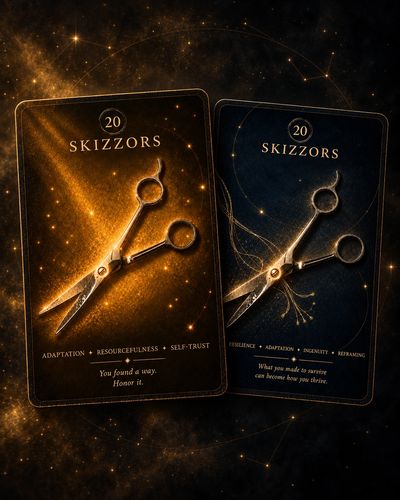
I’m no longer interested in trying to conform in order to fit into places that were never designed for me to belong in the first place.
As a Black woman in leadership, I had spent years adapting, code switching, and making people comfortable in the presence of a highly accomplished Black woman. I was capable of it—but I was also completely exhausted by it all.
When I heard the story behind the Skizzors card, I felt self-trust settle deeply within.
I realized that my whole life was an adaptation that required resourcefulness at many stages. To me, the beauty of this card is the way it holds sacred the contortions one makes in order to adapt. Whether you are adapting to belong or adapting to survive, it probably took a lot.
This card holds deep compassion for all the ways you’ve had to mask and shapeshift. But it also holds a strong energy of grit—the strength to endure unjust conditions, as well as the courage to pave your own way when you’ve had enough.
The fact that the card itself boldly says Skizzors and doesn’t try to explain itself is proof that people can figure you out if they want to.”
~GW